
Beyond Frameworks: Centering Story and Creativity in Evaluation Practice with Taylor Wilson
This past November, I had the opportunity to support and participate in the Canadian Evaluation Society BC Chapter (CESBC) 2025 pre-conference workshop Stories as Pathways: Arts-Based Reflection to Unfold Evaluation Journeys, hosted by the conference’s keynote speaker, Gladys Rowe. I am a young(ish) Cree/Ojibwe/Filipina researcher and evaluator working at the intersection of community and academia, and I have worked with Gladys in various capacities, across several projects, and with many different partners. However, I had not previously had the opportunity to see her work in this way, and this workshop offered a clear example of the depth and care that characterizes her approach.
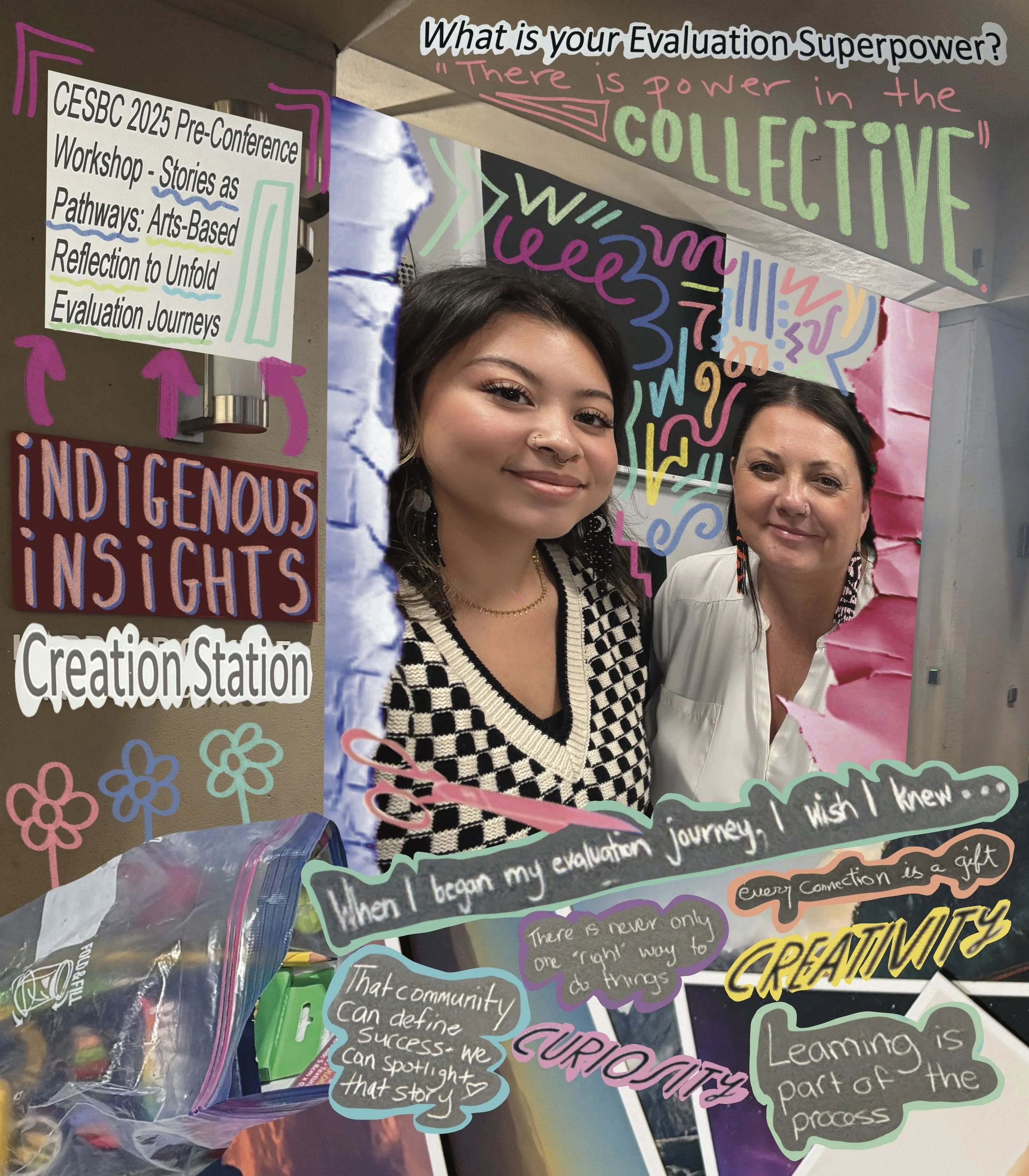
Reflection Collage, Taylor Wilson
In evaluation, it is easy to default to frameworks, indicators, and templates. This session, however, centred story, creativity, and reflection as legitimate and generative evaluation practices. Workshop participants, both self-defined evaluators and those evaluation-curious, were invited to explore an array of arts-based methods, including collage, poetry, zines, photo elicitation, clay work, and quilting. Before stepping outside of my academic training on what evaluation is, and into the world that Gladys and many other evaluators are cultivating, I had viewed these practices not as methods, but as crafts or hobbies. While they are certainly those things, I quickly learned that they are also research and evaluation methods. Participants used them as entry points to reflect on their evaluation journeys, questions were asked like: how they came to this work, what inspires them, what their “evaluation superpower” might be, and which objects or stories represent their evaluation origin stories.
Throughout the day, I did not participate directly, despite the many smiles and invitations to do so. I suspect I would have gotten lost in the activities, which is precisely what I witnessed as a major reason these methods are so effective. What emerged as I moved through the space observing, supporting, and listening was not a single narrative of what evaluation is, but a set of collective narratives that interwove with one another.
Through shared making and group reflection, participants experienced how group-based art activities can function as powerful evaluation tools. These practices lower barriers to engagement, foster low-pressure collaboration, and create space for vulnerability. A key insight from the session was the ongoing reminder that the journey, the pathway, and the process are just as important as the destination, goal, or output. Stories and qualitative ways of knowing have always been central to Indigenous knowledge building and sharing, yet this is sometimes forgotten, even in our everyday lives. These methods are not secondary to evaluation practice, but central to it, and they can open new possibilities for this work.
One phrase shared by a participant stayed with me. It was the only thing I wrote down to ensure I would remember it: “there is power in the collective.” This was evident in the relationships formed in the room and is reflected in the broader work of Indigenous Insights Collective, which continues to model Indigenous-led, relational, and values-driven approaches to evaluation.
Although I did not participate in the activities that day, I was inspired to create something of my own. After leaving the session, I set aside time to reflect and created a collage to hold what we had shared together. For me, the workshop offered insight into evaluation as a space of creativity, curiosity, connection, transformation, and journeying. It was one of many creation stations I will likely return to in my ongoing work with Gladys.
Kinanâskomitin to all who attended, to CESBC for inviting Gladys to host and speak, and to Gladys for letting me tag along.