
Indigenous Insights Collective Year End Reflection Tool: A Conversation with Amanda Burton
As we move toward the close of the year, we’re turning to a practice that grounds our work at Indigenous Insights Collective: taking time to pause, witness our own growth, and honour the stories that have shaped us. In a world that often pushes us toward constant motion, producing and achieving without reflection, this tool offers a different rhythm. One rooted in an anticolonial approach to organizational life. It invites us to make space for care, for noticing, and for affirming the ways our work is intertwined with our values, our communities, and our own becoming.
Indigenous Insights Collective Year-End Reflection Tool was created to help us gently look back on the past year: to notice what strengthened us, what challenged us, what surprised us, and what deserves celebration. It is not an evaluation of performance, but an invitation into a relationship with our work, our learning, our joy, and our hope. We are encouraged to move through it in whatever way feels most nourishing: journaling, drawing, voice notes, or quiet thinking. When the time feels right, we then transform our reflections into a product/representation that can help us hold our insights and when we choose, share them as part of our collective learning journey.
To bring this practice to life, Amanda and I sat together in conversation to reflect on her past year with the Collective - what stretched her, what energized her, and how she is carrying her gifts forward. We invite you to read that conversation as a window into how reflection, care, and relational accountability continue to shape who we are and how we show up.
May this tool help you carve out a moment of stillness, witness your own brilliance, and enter the new year with clarity and intention. With Love - Gladys & Amanda
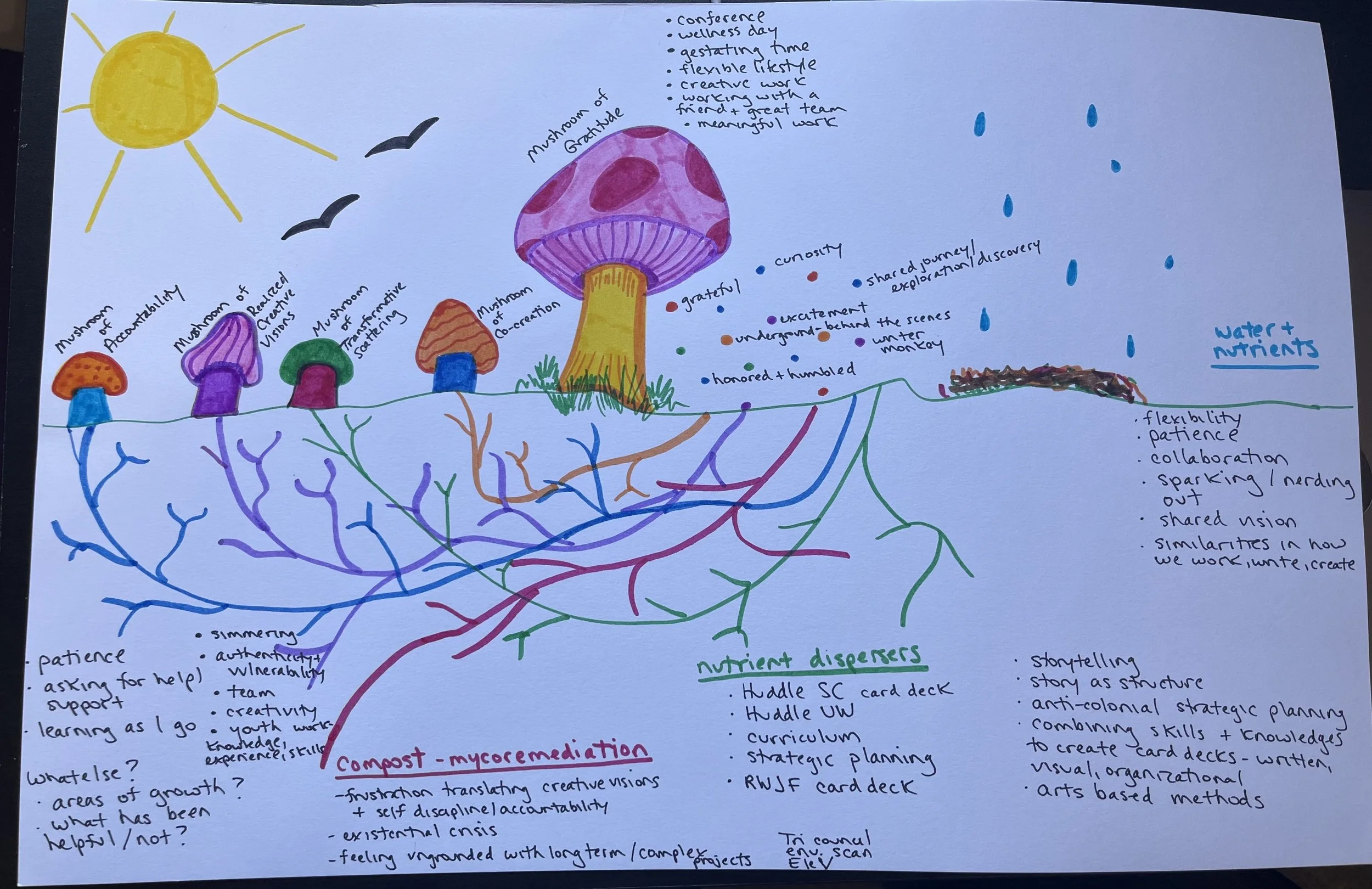
Amanda’s 2025 Year End Reflection Creation
Gladys: Thanks for taking the time to reflect over the past year and being open to testing out this tool that’s really new in thinking about how we might maintain alignment and how we approach things like yearly review processes. I’d love to hear everything you want to share and then also what your experience was with the process and the tool, and if there’s anything that we can adjust moving forward from your perspective.
Are there any starting point reflections maybe you had about what it was like to begin our work together last year?
Amanda: Yes, I was honored and humbled and excited when you asked me to join the Collective. Grateful, and curious about how things would unfold. I was looking forward to a shared journey and exploration, and what that might look like as we grow things together.
Gladys: Based on where you started and where you are now, did you reflect on what you’ve learned about your role or the space that you occupy in the Collective?
Amanda: I had a difficult time coming up with a word or idea around my specific role. It has just kind of flowed… I just go with what you need and it seems to work!
Gladys: Yeah, and the conversation we had at the beginning about your title still hasn’t been resolved. We have our internal projects, external projects, and the other collective members who contribute in different ways so I still don’t have a lot of clarity. And maybe we don’t need that. That’s how I operate but I don’t want to assume that’s a comfortable place of operation for everyone. So talking about role, maybe this container can be more open. I’ve always been so happy and impressed at your ability to translate our conversations into something we can move forward with.
Amanda: I don’t feel the need to have a title or specific box. There have been so many things I’ve gotten to dip into this year and try out so if we’re comfortable with that liminal, amorphous state then let’s go with that.
Gladys: So the next section asks you to reflect on what you did, the main projects or activities, what felt most meaningful or rewarding, and if there was any new skills or knowledge you developed, throughout the year?
Amanda: I loved working on the card decks - bringing together visuals, written materials, organization, and incorporating past skills in the therapy realm. It was a lot of fun working with the youth and playing with a new tool. I also loved the opportunity to explore arts-based methods - it’s very joyful to see people from all backgrounds respond so positively to the activities. Unexpectedly, I also really enjoyed working on our anti-colonial strategic planning framework - I have been finding many rabbit holes to go down.
Gladys: I really saw your passion and aliveness in so many different areas of the work - like you said, bringing all of the different pieces of your experience and helping to create something that’s completely new. And then also seeing how you take a lot of information and digest it into something tangible and usable, I really appreciate that about you and your brain and it was one of the reasons I was really excited to work together. I love our conversations where I’m like, this is what I’m seeing, but I don’t know what it is yet and you happily pick that up and bring together lots of different resources to create something beautiful.
Amanda: I really love how we work together in that way. We just pass things back and forth, work through them together. I think we collaborate really well. I love those sparking moments, a shared vision coming into focus. You create a very easy space to do this work - it feels spacious and like there is room for playfulness and rabbit holes.
Gladys: Yeah thanks for that. Our team really does invite people to be curious and figure out what’s going to work for them and sometimes that might feel too big. So what’s important for me is space for open communication about how things are feeling and whether there needs to be more processes or containers to make things more manageable.
Amanda: This way of working really suits me personally but it might be something to explore deeper as Indigenous Insights expands - others may like having more fences around what they’re doing.
Gladys: Yeah. So the next section asks you to reflect on challenges and growth, thinking about challenges or obstacles you experienced, how did you approach or move through those experiences, what did you learn about yourself in that time, and is there anything that could be approached differently?
Amanda: In some ways this has been a really hard year outside of work - the US election last fall and the impact that’s had on Canada. It’s been a bit of a general sense of the world going to hell in a handbasket, you know? So I've reflected a lot on what it is that I can do with the gifts I have, who I am, and what I can offer through our work. Accepting that that can be enough.
I’m also thinking about the idea too, that “there’s always parts of your job you don’t like” and I’m wondering if that’s true or if that’s a colonial idea. Maybe all of the work we do, we can love and enjoy while acknowledging challenges and different dynamics that are part of being human.
Gladys: Yes. Anything else in this area?
Amanda: Yeah, I’m feeling some frustration around translating visuals that I have around our work into more concrete forms. I can see what I want to create in my mind, but don’t have the skills to turn that into something we can use so if that’s in line with what you’d like me to be doing, that’s something we could look at.
Gladys: I would really love, if that's an area that you're feeling called to, it would be an amazing addition to how we can work on projects and communicate in a multidimensional way.
Amanda: Yes, I would love to be able to nurture the more visual artistic skills that I have.
Gladys: So, the next one is celebrating achievements - are there any you wanted to share that you're most proud of, or where you felt especially successful or valued?
Amanda: I think we talked about this a while ago but the whole experience has felt too good to be true, even though it is true and it’s happening. I’m just so grateful for everything. And yeah, I do love doing the card decks and the visuals and I know that’s an area for further growth which is also exciting. I like to challenge myself. It’s hard to pick out specific things because it’s just an overall good way of being. Work just blends in with my life. Like I’ll be reading a book for my own enjoyment but I’ll be plastering it with sticky notes because it will fit into a project that we’re working on. There’s not a lot of separation between work and life but it’s a good thing. It feels natural.
Gladys: Yeah and I’m so grateful to have another human being that can talk through, and share, and imagine and go further with than I could have on my own. It’s been really lovely to feel supported and to have you walk with me in this work and I really appreciate your genuineness and care and attention that you take with everything you do. Are there any other insights that you want to make sure to carry forward into your coming year, or any other skills or areas that you want to explore or focus on?
Amanda: Being accountable to myself, and to you, and to the team. I would say mostly to myself, because I think I'm pretty good with being accountable to other people, but sometimes not so much with myself. Challenging myself with the digital art and visual representation and being consistent with it. I tend to get frustrated and like, I don’t have the capacity to learn all this stuff but I also don’t believe that so just being a little more intentional. Making some time during our check ins to see how that is progressing. I would really love to be able to reproduce what I see in my brain into beautiful, creative, and fun things for our clients and for our internal work.
And then the transformative scattering piece I noted is related to the idea that there's only so much that we can do. As a collective, as individuals, we as humans, and so just scattering… scattering seeds and doing our best to nurture them and support them, but letting it go, letting the outcomes go.
Gladys: Yeah because we don’t have control over that.
Amanda: Exactly. Just planting the seeds, taking care of them the best we can and then letting life happen. Or not. The co-creation piece is talking about how we work together, bounce ideas off of each other, sparking one another’s ideas and running with them. And same with the people we work with - I think there’s value in doing things alone and nurturing your own nascent ideas but then also coming together and seeing where they can transform. When someone picks up an idea and makes it more fulsome and relevant. And then the co-creating with you to grow your company the way you want it to, have it be sustainable and meaningful, and all those things.
Gladys: We’ve kind of touched on some of your goals but what are some of the things that you really want to pay attention to working on, or maintaining, in the coming year?
Amanda: Well, the digital art skills and graphic design. Building my systems change knowledge and being more equipped to support you in getting projects off to a good start. Being experiential in my learning and taking a bit more initiative so that I am consistently challenging myself.
Gladys: Hmm I like that, being experiential.
Amanda: I don’t need to tell you this, but it’s not the kind of work where you read a textbook and you’re like, oh, I’m gonna go do this, right? Every project is different, and every group is different, and you can build in those frameworks but it’s a matter of being adaptable and flexible, meeting the individual needs of the project and people involved.
Gladys: Yeah, yeah. I talk about this in a lot of different spaces - building my bundle - and so I have my understanding of my own personal bundle that I carry, and also my research and evaluation bundle which I wrote about in the Indigenous Evaluation Bundle Report and in my methodology for my dissertation as well. This is the bundle of experiences, skills, questions, people, mentorship, learning, curiosities that I carry, tools, and it is something that I keep collecting over the years. And as our careers expand and travel, we can draw from those experiences in a really interdisciplinary way, which is why I love this work, and why I did my interdisciplinary PhD because boxes can’t hold me in. We have the really beautiful, creative, critical opportunity to digest and assess, what fits, what do I want to carry with me? So your goal around naming systems change learning you’re going to completely do what you do - finding all of the resources, having stacks of books, and going down rabbit holes online because I know that’s what you do when you have something you’re learning about or really want to understand more.
Amanda: For most of my life, my natural inclination is to be a book learner. I liked school, reading, writing papers (maybe to a lesser degree). But working with Michael [Hart] really shifted my way of learning and working in a more experiential way. I think it’s important to have both aspects working together to gain a wholistic understanding of something.
I was reflecting this morning that I tend to get bored easily but with this work I could do it for a long time because there’s always something you can learn or a different skill you can build, so many interdisciplinary pieces, so that’s very cool and fits well with my brain. I also like that I can be doing some heavy writing one day, and then when that stops flowing, jump to some professional development pieces, or dip into different things and still being doing the work but not tied to specific tasks at specific times. There’s a natural fluctuation and fluidity to the work.
Gladys: I think you named some of these already but thinking about your strengths and ways of showing up, how might that support the goals you’re working towards, and how might me and the team support those goals?
Amanda: I like how you send me resources that you see out in the wild that you think would be supportive, and you are very patient with me. I’m hard on myself with not knowing everything right away. Having the beginner’s mind and understanding that this is a process, not just something you pick up and run with. So also giving myself that grace with learning new skills. I do well with having some structure, like the university course style, with expectations built in and then supplementing that with other less formal resources.
With the team, I think we all work really well together and support each other so I don’t have anything specific. It just seems to work.
Gladys: I’m curious, if you feel like I’m giving you too much space, not enough space to grow and be challenged. If there is good feedback, consistency, pace, that you’re not left out somewhere wondering about things.
Amanda: I don’t feel like you’re throwing me to the wolves but you also don’t micromanage so it’s a good balance for me. I think my main thing is just that I want to make sure I am doing enough to support you. That matters a lot to me, that you feel supported and that I’m meeting the initial expectations and hopes you had when we first started out last year.
Gladys: It’s been so impactful and meaningful for me having you as part of the team, someone to experience this journey with me. I feel like that has been really profound and a big part of this process has been me figuring out my own stuff - how to work with someone in partnership and not just me always having to be responsible for everything. That was a challenge I named for myself and I hope that feels like I’m a bit better there. Every time I ask you to show up and do something, you completely do and there’s nothing that I’ve thought twice about asking and so there isn’t a gap there. I’m definitely not thinking that you are doing less than you should be or that you aren’t contributing enough. I’m really excited for you to develop some of these new skills because I know that will be really helpful for our team. The graphic storytelling and those pieces. That’s going to be a leveling up of what we can do together, so I am really looking forward to that.
Amanda: Thank you for all of that. I know how hard it is to let things go and trust people with what’s important to you, so that’s a big honor for me that you trust me. I know it’s hard to delegate when you’re used to working on your own so I want to find that balance of being supportive without overstepping or pushing you to let go of what you may not be ready to release.
I’m just so grateful that I get to work with you, for the flexible lifestyle the job affords, the good income and opportunities that you offer, and so I just really want to make sure that that’s flowing back to you.
Gladys: Yeah that’s beautiful. Is there anything else you want to pay attention to before we wrap up?
Amanda: No, just thank you for everything.
Gladys: Thank you as well.